Wednesday, May 22, 2013

UNIT 1 day 3

-Suface Area-

 Surface area is the total area of the surface of a three-dimensional object.

(surface area examples)

Surface Area of a Cylinder = 2 pi r 2 + 2 pi r h


The surface area of a prism = 2 × area of base  +  perimeter of base × H

Pyramid-[Base Area] + 1/2 × Perimeter × [Slant Length]

Cone-SA = πr2 + πrl

Surface Area of a Sphere = 4 pi r 2


an example of when we would use surface area, is anytime we need to know how much of something will fit into a 3-d figure, such as being a plumber. They need to measure pipes and find the surface rea and volume to know how much water can and will fit. Or also when they checked out the pyramids, they needed to use surface area to know the overall size. Surface area is hugely used in engineering as well.


Here's a practice quiz!
Calculate all surface areas


KEY


Problem one:


For both the front and back faces, l = 5 in. and w = 2 in.
So, the area of the front and back faces is,
 2  2 = 20 in.2
For both the top and bottom faces, l = 14 in. and w = 5 in.
So, the area of the top and bottom faces is,
14  5  2 = 140 in.2
For both the sides, l = 14 in. and w = 2 in.
So, the area of the two sides is,
14  2  2 = 56 in.2
Add the area of the faces.
20 + 140 + 56 = 216
So, the total surface area of the given solid is 216 in.2.


Problem 2:

The triangular prism has triangular bases.
So, to find the area of the bases, use the formula:
Substitute 6 for b and 8 for h.
Therefore, the area of the two bases is,
2(24) = 48 cm2
The triangular prism has rectangular sides.
So, use the formula A = lw to find the area of the sides.
The area of the front side is,
13  8 = 104 cm2
The area of the bottom side is,
13  10 = 130 cm2
The area of the back side is,
13  6 = 78 cm2

Find the sum of the base areas and the area of the sides.
48 + 104 + 130 + 78 = 360
So, the total surface area of the given solid is 360 cm2.


Problem three:

The area of the curved surface of a circular cylinder of base radius r and height h is 2πr ·h.
Here, r = 4 and h = 161/6. So, the area of the curved surface is,
2 ·π· 4 · 161/6
To simplify, first write the mixed number as a fraction.
2 ·π· 4 · 161/6 = 2 ·π· 4 ·97/6
Now, multiply.
2 ·π· 4 ·97/6 approx 406.3
So, the area of the curved surface is about 406.3 in.2.
he cylinder has circular bases.
So, the area of each base is πr2.
Here, r = 4. Therefore, the area of the two bases is,
2(π· 42)
Simplify.
2 ·π· 42 = 2 ·π· 16  100.5
Add the area of the bases to the area of the curved surface.
406.3 + 100.5 = 506.8
So, the surface area of the given solid is about 506.8 in.

Tuesday, May 21, 2013

UNIT 1--day 1

In this Blog entry, we will teach you how to find the area of a square, rectangle, triangle, trapezoid, parallelogram, circle and a polygon. Also, we will define what a point, a line, segment, ray, angle, median, altitude and perpendicular, along with some practical application.

The area formulas are as follows:
Square:
A^2 where "A" is a side length.

Triangle:
1/2 (b x h)
B= base length
H= height

Rectangle:
W x H
W= width
H= height

Circle:
3.14 x  r^2
R=radius

Parallelogram
B x H

Trapezoid:
 1/2 (a+b) x H
A= side length one
B= side length two
H= height

Polygon
 1/2 (apothem) (perimeter)


Also, we need to define...


Point:A point is an exact position or location on a plane surface. It is important to understand that a point is not a thing, but a place.

Line: A straight slope showing either growth, decline or constancy on a graph. extends infinently from both sides

Plane: A 2 dimensional figure

Line Segment: A part of a line with two dots on either end, sectioning off a part of a line, finite distance

Ray: a line that extends infinently in one direction

Angle: A shape created by two lines or rays diverging from a common point

Median: the middle

Altitude: otherwise known as the height of a triangle.


Perpendicular: A line is perpendicular to another if it meets or crosses it at right angles (90°). 


QUIZ
A- a triangle has a base of 5 and a height of 2, what is the area?
B- a circle has a radius of 20, what is the circumference?
C- a parallelogram is 30 by 20ft, what is the area?


answers
A-area is 5ft2
B- 396.6ft2
C- 50ft2 


Friday, May 17, 2013

DAY 6 -find an equation of a line with two points-

-find an equation of a line with two points-
basically stating, find a y=mx+b equation with 2 points
refer to entry 2, but in a real life setting


Here I have a price per amount in a bag full of paintballs.
I have 2 points that are (100,$4.00)
and I have ( 400,$14)
so i take the 400 and 14 and I simplify 400,14 so it equals 200 and 7
I divide the 200/7
and that equals+28.5


After its in the form
y=28.6x+b
I take the number 100 and $4


I add the Y to the Y=
and i add the X to the X

$4=28.5(100)=b

after i do the equation is should be
4=2850+b

Then i subtract the 4-2850 and that gives me -2846

so stating, they charge 28.46$ without purchasing any paint and just for advirtisement.
Entry:5
         In order to graph a linear equation, we can use the slope and Y intercept to graph it, and visually show the data the formula states.
For this example, we have a formula of: Y=1/2x+4


One way to graph it, is using the X and Y values of two points that satisfy the equation, plot each point and then draw a line through the points. You can start with any two x values you want, and then find "y" for each ''x''  by substituting the ''x'' values into the equations, Try it with X=1
If the value of x is one, and the formula is Y=1/2x+4, you should have written down "Y=1/2*1+2=1/2+2" Which then gives you a value of Y, which, after solving should be 2.5. 
The "B" value in the equation can be used a start point for your graph, and then you can use rise over run to graph the lines.


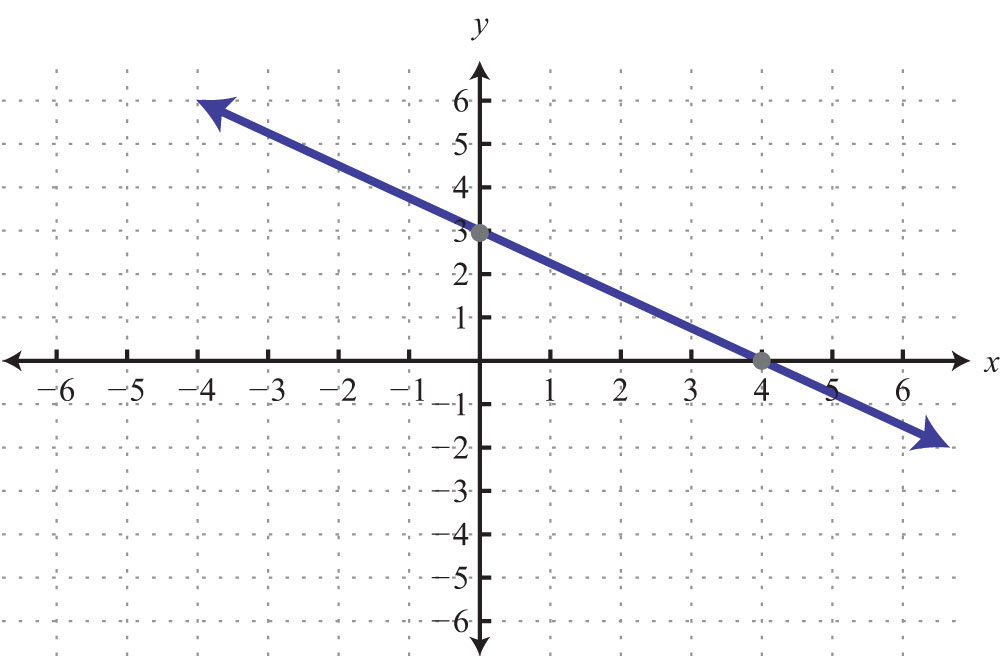
You can also work backwords to find the equation from a graphed line,
Let's Practice


Monday, May 13, 2013

Day 4: define Y intercept and "real world meaning"

Entry 4
Define the "Y" intercept


The y intercept is where the the line of the equation crosses the y axis.


As you can see, the Y intercept is the point at (0,0). Basically saying, in real life, the Y intercept in this meaning would mean, if you didnt do your homework, then, you get a 0 on your math test. And if you increase the Y intercept, it means that's your test score, based on the amount of homework that's been completed.


http://2012books.lardbucket.org/books/elementary-algebra/section_06/28f569d8aec92ab40c5f113f18f7f591.jpgKnow that you know the dictionary definition of the Y intercept, lets practice. Here are a few graphs.


Slope and Y-Intercept


Use the Red line only


ANSWERS:
Graph 1: The Y intercept is (0,3)
Graph 2: The Y intercept is (0,18)
Graph 3: They Y intercept is (0,1)
Entry 2: How to find linear equations.
Linear equations are, simply the Y=Mx+b formula for graphing a line. This is commonly referred  to as he slope intercept form, because the equations states both the slope and the Y intercept.
The "M" gives the slope, and the "B" gives the "Y" intercept.
Here's an example:


  • Find the equation of the straight line that has slope m = 4
    and passes through the point 
    (–1, –6).

In this instance, they have given you the value of the slope. Specifically, "M=4". So at this poin, you can plug that into the equation as: Y=4x+b

They have also given you an X and Y value, -1 and -6 respectively. In the slope intercept form of a straight line, You have Y, M, X and B, all you need to do now is plug in what they have given you for the slope and the X,Y from the given point, and solve for B. like this:
Y=mx+b
(-6)=(4)(-1)+b
-6=-4+b
-2=b
 Congratulations! You just found the linear equation!! But what if they don't give you the slope?

Find the equation of a line that passes through the points (-2,4) (1,2) 

Well,this is where you would use the slope formula! The slope formula is an easy method to find the slope of a line.
If you have two points on a straight line, you can always, ALWAYS find the slope with this method.


After plugging in and solving, the slope you should have gotten is -2/3

Now that you have the slope AND two points,you can solve for the equation. Lets use point (-2,4)
Y=mx+b
4=(2/3) -(2)+b
4=4/3+b
12/3-4/3=b
B=8/3
So, y=(-2,3)x+8/3
The answer is the same no matter which point you use. Now lets practice!

With this equation Y=5/3x+2, graph the line using the same method above.


This should have been simple, because you have the full equation, and all you need to do is graph it.